Every travel trailer is sold with a weight on the headline of the brochure — and it's almost always the number that tells you the least about whether you can safely tow it. The figure that actually matters is the one the trailer weighs after you've loaded it for a trip, and that depends on four or five numbers that rarely sit together on the same marketing page. This guide walks through each one, what it really means, and how they add up — using verified figures from trailers in our catalog.
01 The five numbers that matter
Spec sheets use a soup of acronyms, and manufacturers don't all label them the same way. These are the five you need, in plain terms.
Dry WeightUVW / unloaded vehicle weight
What the trailer weighs as it leaves the factory — empty tanks, no gear, often no options or batteries. This is the headline brochure number. It is useful for comparing trailers against each other, but you will never tow the trailer at this weight.
Gross Vehicle Weight RatingGVWR
The maximum the loaded trailer is allowed to weigh, set by the manufacturer. This is the ceiling: fully loaded with water, propane, gear and passengers' belongings, the trailer must stay at or under this number. It is the single most important figure for matching to your tow vehicle.
Cargo Carrying CapacityCCC / net cargo / payload
The difference between GVWR and dry weight — how much stuff you can actually add. This is where families get caught out: a trailer with a tempting dry weight but a thin cargo capacity can be effectively 'full' before you've packed a thing.
Tongue / Hitch WeightTW
The downward weight the loaded trailer puts on the hitch ball. It is typically 10–15% of the loaded trailer weight, and it matters for two reasons: it eats into your tow vehicle's payload, and too little of it causes dangerous trailer sway.
GAWR & tire ratingsaxle / tire limits
The most-overlooked numbers. Each axle and each tire has its own weight limit. A trailer can be under its GVWR overall and still overload one axle if you pack it badly. Worth a glance, especially on single-axle trailers.
02 Why the brochure number lies (a little)
The dry weight on the front of the brochure is real, but it describes a trailer you will never actually tow: no fresh water, no propane in the tanks, no battery, frequently none of the options the unit on the lot is fitted with. The moment you fill the fresh tank and load up, the real number climbs — often by a thousand pounds or more.
The number that bites
Water is heavy: it weighs about 8.3 lbs per gallon. A 54-gallon fresh tank, full, adds roughly 450 lbs on its own — before a single sleeping bag goes in. Propane adds about 4.2 lbs per gallon; two 30-lb bottles add another 60 lbs. None of that is in the dry weight.
03 A worked example, start to finish
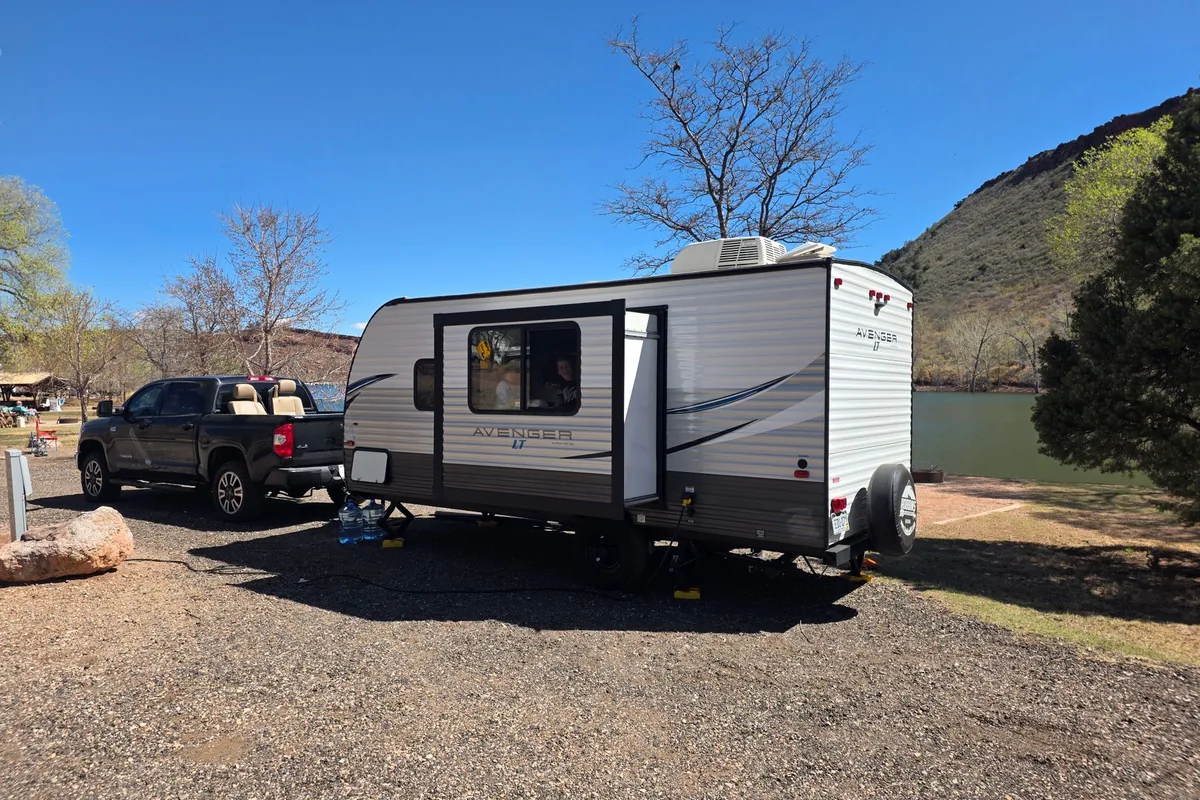
Take a real, mainstream trailer from our catalog — the Forest River Rockwood Mini Lite 2205S, a single-slide half-ton-friendly travel trailer. Here are its verified 2026 numbers, and what happens when you load it.
| Dry / unit base weight | 5,132 lbs |
| GVWR (the ceiling) | 6,794 lbs |
| Net cargo / payload (CCC) | 1,662 lbs |
| Tongue weight (empty) | 634 lbs |
| Fresh water capacity | 54 gal |
That 1,662 lbs of cargo capacity sounds generous — until you start spending it. Here's a realistic family load:
| Fresh water (54 gal × 8.3) | 448 lbs |
| Two propane bottles | 60 lbs |
| Battery + basic gear | 120 lbs |
| Food, clothes, kitchen, bedding | 400 lbs |
| Camp chairs, grill, generator, tools | 250 lbs |
| Loaded so far | 1,278 lbs |
You're at 1,278 of 1,662 lbs — comfortably under, but with less headroom than the brochure implied, and you haven't added bikes, a full water heater, or a loaded outdoor kitchen yet. Loaded, this trailer weighs about 6,410 lbs and puts roughly 770–960 lbs on the hitch. Those are the numbers your tow vehicle has to handle — not the 5,132 on the brochure.
04 Matching it to your truck
Now flip to your tow vehicle, and check the loaded trailer against three of its limits — not just its advertised "max towing" figure, which is measured under ideal conditions you'll never replicate.
Tow rating vs. reality
The big "tows up to 7,500 lbs!" number assumes a near-empty truck with one driver and nothing else. Every passenger, every cooler, and the trailer's own tongue weight comes out of that figure. Aim to keep your real loaded trailer weight at roughly 80% or less of the advertised maximum to leave a safe margin.
Payload is the hidden ceiling
Here's the trap that catches more buyers than tow rating: your truck's payload (on the door-jamb sticker) has to cover passengers, cargo and the trailer's tongue weight. A 900-lb tongue weight can eat most of a half-ton's payload before the family climbs in. Always subtract tongue weight from payload, not from tow rating.
Quick gut-check
Loaded trailer weight under ~80% of your truck's tow rating, and tongue weight + passengers + cargo under your truck's payload sticker. If both are true, you're in good shape. If either is tight, size up the truck or size down the trailer.
05 Bigger trailer, same math
The logic doesn't change as trailers get larger — the numbers just get less forgiving. Compare the 2205S above with a much bigger bunkhouse from the same family, the Rockwood 2918BH:
| Exterior length | 35' 5" |
| Dry / unit base weight | 7,851 lbs |
| GVWR (the ceiling) | 9,900 lbs |
| Net cargo / payload (CCC) | 2,049 lbs |
| Tongue weight (empty) | 920 lbs |
More cargo capacity (2,049 lbs) — but a 920-lb empty tongue weight that will climb past 1,100 lbs loaded. That's firmly out of half-ton payload territory and into three-quarter-ton truck country. Same five numbers, same method; the trailer just tells you plainly that it needs a bigger truck. That's exactly what the weight numbers are for.
06 Your pre-purchase checklist
Before you sign anything, run the trailer's spec sheet through this:
- Find the GVWR, not just the dry weight — that's your real ceiling.
- Check the cargo capacity (CCC) and ask honestly whether your packing list fits inside it.
- Add ~450 lbs for a full fresh tank if you travel with water aboard.
- Estimate loaded tongue weight at 12–15% of loaded trailer weight.
- Subtract that tongue weight from your truck's payload sticker, then add passengers and cargo.
- Keep loaded trailer weight at ~80% or less of your truck's advertised tow rating.
- On the lot, weigh the actual unit if you can — options push real dry weight above the brochure figure.
The one-sentence version
Ignore the brochure's dry weight, work from GVWR and your truck's payload sticker, and remember that a full fresh-water tank quietly adds the weight of two passengers. Do that and you'll never be the rig white-knuckling it in the slow lane.